


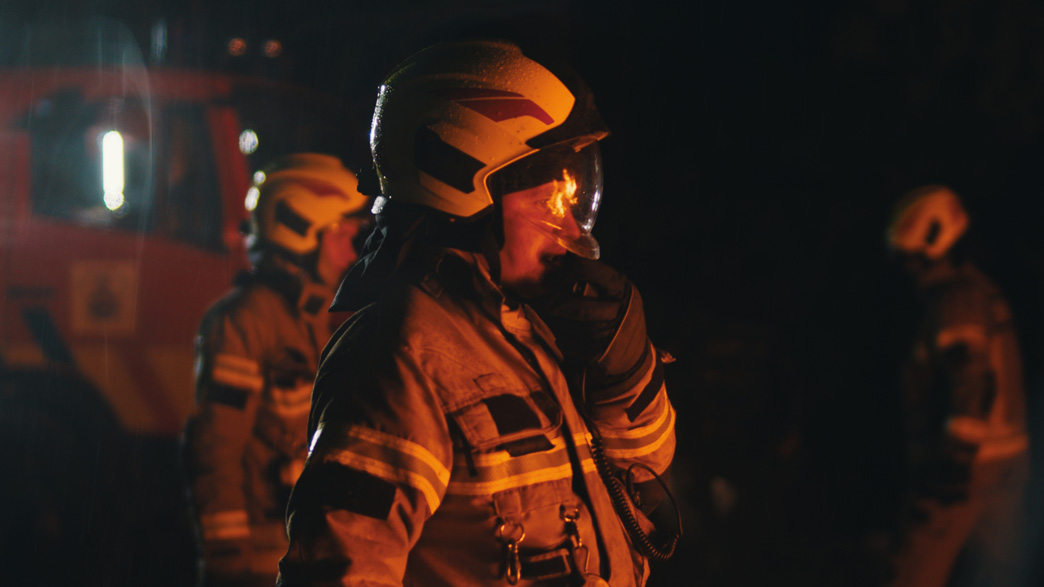
There are few pieces of equipment more important to a firefighter than the means to communicate. Firefighters enter environments which most people would shy away from. When conditions deteriorate rapidly, buildings behave unexpectedly or the operational plan must change, the most important piece of equipment may be the one that allows a simple message to be passed clearly, quickly and without misunderstanding.
Considering my career in service and now post-service, the development of communication methods has been astounding. From being committed to building fires with no communication, reliant on whistle evacuation signals and shouting to be understood by my BA partner, through to commanding incidents and relying on crews to follow their briefing and employ their knowledge and skills, to the gradual development of BA communications equipment and the ability to receive direct feedback from working crews. Fireground radios with limited range. Main scheme radios on different frequencies between services, some on VHF, some on UHF. The journey has been significant.
When we consider the Incident Command System, it becomes clear how the lines of communication are structured and how essential they are to safely delivering the strategic, tactical and operational plan. Firefighter communications are the lifeline of the incident ground, underpinning situational awareness, tactical decision-making, firefighter accountability and multi-agency coordination. When communications work well, they are often taken for granted. When they fail, the consequences can be immediate, serious and sometimes fatal.
This subject is therefore not simply about radios or networks. It is about interoperability, operational confidence and command resilience. It is about ensuring that the firefighter entering the building, the BA team working in heat and smoke, the pump operator, the aerial operator, the ambulance commander, the police commander and the control room are all working from the same understanding.
From the shouted message to the digital network
For much of the fire service’s history, communication on the fireground was physical, visual and verbal. Hand signals, shouted instructions, runners and whistle signals still have value at small incidents and within close crew operations, but they are limited by distance, noise, smoke, building complexity and the pace of developing incidents.
The introduction of handheld radios transformed fireground command. Portable radio allowed officers to communicate with crews, pumps, control rooms and specialist functions without physically leaving the task area. However, filtering information was always essential. Too much information creates decision paralysis for incident commanders. Structuring communications in line with the ICS ensures the right information reaches the right person in the command structure, maintaining situational awareness and facilitating quality decision-making.
Early radio systems suffered from poor coverage, interference and limited battery life. Local workarounds helped, but they were never a complete solution.
The move to digital radio marked a major step forward. Improved security, clearer audio, group management, emergency button functionality, status messaging and more structured control of talk groups all followed. For fire and rescue services, talk groups could now reflect operational sectors, command structures and specialist functions. Emergency alerts could be escalated quickly. The key benefit was not simply that the radio became digital, it was that communications became more operationally structured.
In the United Kingdom, the FireLink/Airwave project delivered the transition from a patchwork of local analogue arrangements onto a common digital platform. It was more than a technical upgrade. It improved national resilience and interoperability while demonstrating that new communications systems require changes in training, procedures and organisational culture as well as equipment.
Interoperability: Talking is not the same as communicating
Major incidents rarely belong to one agency. Interoperability is therefore not simply the ability to connect one radio to another. It is the ability of organisations to work together coherently under pressure.
The Joint Emergency Services Interoperability Principles remind us that communication is only one part of joint working. Co-location, coordination, joint understanding of risk and shared situational awareness are all essential. Communication technology only succeeds when agencies share the same operational understanding.
This is where standard messaging becomes critical. Models such as METHANE bring structure to the first report from a major incident, reducing ambiguity and giving commanders a common framework. A clear assistance message, emergency evacuation signal, BA emergency message or sector report can change the outcome of an incident. For firefighters, standard messages are not administrative exercises. They are life safety tools.
Radios connect people. Doctrine connects decisions.
The breathing apparatus challenge
Communications become most difficult in the very environment where firefighters need them most.
Many firefighters will recognise the historic problem of muffled, distorted or broken messages from BA teams. A message that sounds clear to the sender may be almost unintelligible to the receiver. Improvements in speech diaphragms, facepiece design, in-mask microphones, remote speakers and integrated voice amplifiers have all helped, but there remains no single perfect answer.
An effective system must combine compatibility with PPE, comfort, durability, audio quality, battery life and the ability to operate under stress. A system that performs well in a quiet demonstration room may not perform on the incident ground. Testing under realistic operational conditions is not optional. It is essential in any procurement process.
The future: Intelligence, not just information
Firefighter communications are entering another phase entirely. The Internet of Things, smart buildings and digital infrastructure are creating a new operational environment, and I see this as a major opportunity.
Imagine an incident commander receiving live internal location data from BA teams, drone imagery from the roof sector, hydrant information, building plans, fire alarm zone data, hazardous materials information and casualty reports on a resilient command platform. Imagine a BA entry control officer able to monitor team location, cylinder pressure and distress alarms in real time.
Many of these capabilities already exist, but the challenge is no longer collecting more information; it is presenting the right information at the right time. Future systems must simplify, prioritise and support decision-making rather than overwhelm commanders.
Artificial intelligence has the potential to filter data, identify emerging risks and compare live conditions against pre-incident plans, but it must support command, not replace it. The incident commander remains responsible for tactical judgement and firefighter safety, supported by accurate, cyber-secure and resilient information that strengthens situational awareness and operational decision-making.
More data does not automatically mean better command. Too much information, poorly presented, can slow decision-making. Future systems must be built around operational usability. Technology should simplify, prioritise and support, not distract.
The future should not be a firefighter standing outside a building surrounded by screens and uncertainty. It should be a commander supported by clear, trusted and prioritised intelligence that improves situational awareness, shortens decision time and strengthens firefighter safety.
Communications as a critical control measure
Firefighter communications are a critical control measure, underpinning firefighter safety, effective command and organisational resilience.
The journey from analogue handheld radios through digital systems, structured interoperability and SCBA-integrated communications represents real progress. Yet the fundamental requirement remains unchanged. Firefighters need to communicate clearly in the most hostile environments we ask people to enter.
The future will bring richer information, improved firefighter tracking, live video, resilient broadband and smarter systems. But the principle must remain simple.
When a firefighter presses the button, the system must work.
That is why communications are not an accessory to firefighting. They are the firefighter’s lifeline.
This feature appeared in issue 70 of Fire Middle East magazine.


